Episode Summary
Executive Summary: This episode argues that capitalism and democracy are interdependent and need each other as checks and balances. Using Silk Road, monopoly power, referenda, U.S. political drift, and historical examples from the Cold War to fascism, the hosts contend that concentrated wealth and power undermine both markets and democratic legitimacy, while broad participation and institutional rivalry help keep each system healthy.
Main Topics: Capitalism and democracy as mutual checks: The hosts frame capitalism and democracy as a balancing act: democracy limits extreme wealth concentration, while capitalism limits state overreach and helps preserve incentives and pluralism. Silk Road as a cautionary tale about anarcho-capitalism: The Silk Road is used to illustrate that even a market-centered system requires enforcement, rules, and a state monopoly on legitimate violence; without them, abuse and blackmail emerge. Money, lobbying, and elite influence in U.S. democracy: The conversation highlights how money in elections, lobbying, philanthropy, and regulatory capture distort democratic decision-making and weaken impartial rule enforcement. Historical shift from moral guardrails to plutocracy: The speakers contrast older norms of restraint and civic duty with today’s environment, where regulators and business leaders often overlap and wealth increasingly shapes institutions. Role of alternatives, ideology, and the Cold War: They argue that the existence of communist alternatives and strong ideological competition once kept capitalism and politics more honest; after the Soviet collapse, business influence grew unchecked. Democracy, nationalism, and globalization: The episode discusses Danny Rodrik’s trilemma and suggests that deep economic integration, nation-states, and democracy are difficult to sustain simultaneously without tension. Authoritarian capitalism and fascism: Examples from Hungary, Chile, Weimar Germany, and Italy/Germany are used to show how concentrated ownership and elite fear can support authoritarian consolidation.
Key Arguments: Capitalism cannot function properly without a functioning democracy because rules must be enforced impartially and broadly. Anarcho-capitalist experiments still depend on state-like enforcement; the Silk Road showed how quickly rule-free markets collapse into coercion and blackmail. Democracy works best when many people participate as referees, making it too costly for special interests to buy the system. Extreme inequality enables the wealthy to build systems that protect and amplify their power, pushing society toward plutocracy. Direct democratic mechanisms like referenda can reduce capture by vested interests compared with standard legislative processes. The decline of ideological competition after the fall of the Berlin Wall reduced the moral and political pressure on business and elites. The U.S. has moved from a period of anti-business regulation and social tension to one where wealth and business heavily influence media, academia, politics, and regulation. A certain degree of nationalism or civic cohesion may be necessary to keep capitalism bounded and democracy functional in a globalized economy. Concentrated ownership and monopolies can help authoritarian movements consolidate power once they gain office. Checks and balances in both economics and politics are essential; concentration of power in either sphere is dangerous.
Data Points: Silk Road launch year: 2011 - Ross Ulbricht launched the anonymous black-market website in 2011. Largest loss by Carlos Slim mentioned: $30 billion - Bethany describes Slim losing $30 billion in one year after telecom deregulation in Mexico. Florida felon voting rights initiative: 2018 - A referendum restored voting rights to many felons who had completed their sentences. U.S. 1970s policy environment: 1970s - Referenced as a period of price controls, wage controls, capital restrictions, and high tax rates. Historical reference point: Fall of the Berlin Wall / end of Cold War - Cited as a turning point that weakened ideological checks on business power and increased globalization. Economic integration theory: 3-part trilemma - Danny Rodrik’s trilemma: nation state, deep economic integration, and democracy cannot all coexist fully at once.
Pivotal Quotes: "capitalists can only survive properly in a well-functioning democracy" — Lucia Zingales: Core thesis linking market capitalism to democratic institutions. "the pendulum has shifted too much in the direction of plutocracy in the last 20 years in the United States" — Lucia Zingales: Warning that wealth concentration is undermining democratic balance. "the system of verification relies on everybody being a verifier" — Lucia Zingales: Used to explain why broad participation makes democracy harder to capture.
Implications: The episode warns that unchecked wealth, lobbying, and regulatory capture can hollow out both democracy and markets. For listeners, the takeaway is that healthy capitalism requires strong institutions, broad civic participation, and limits on concentrated power.
About Capitalisnt
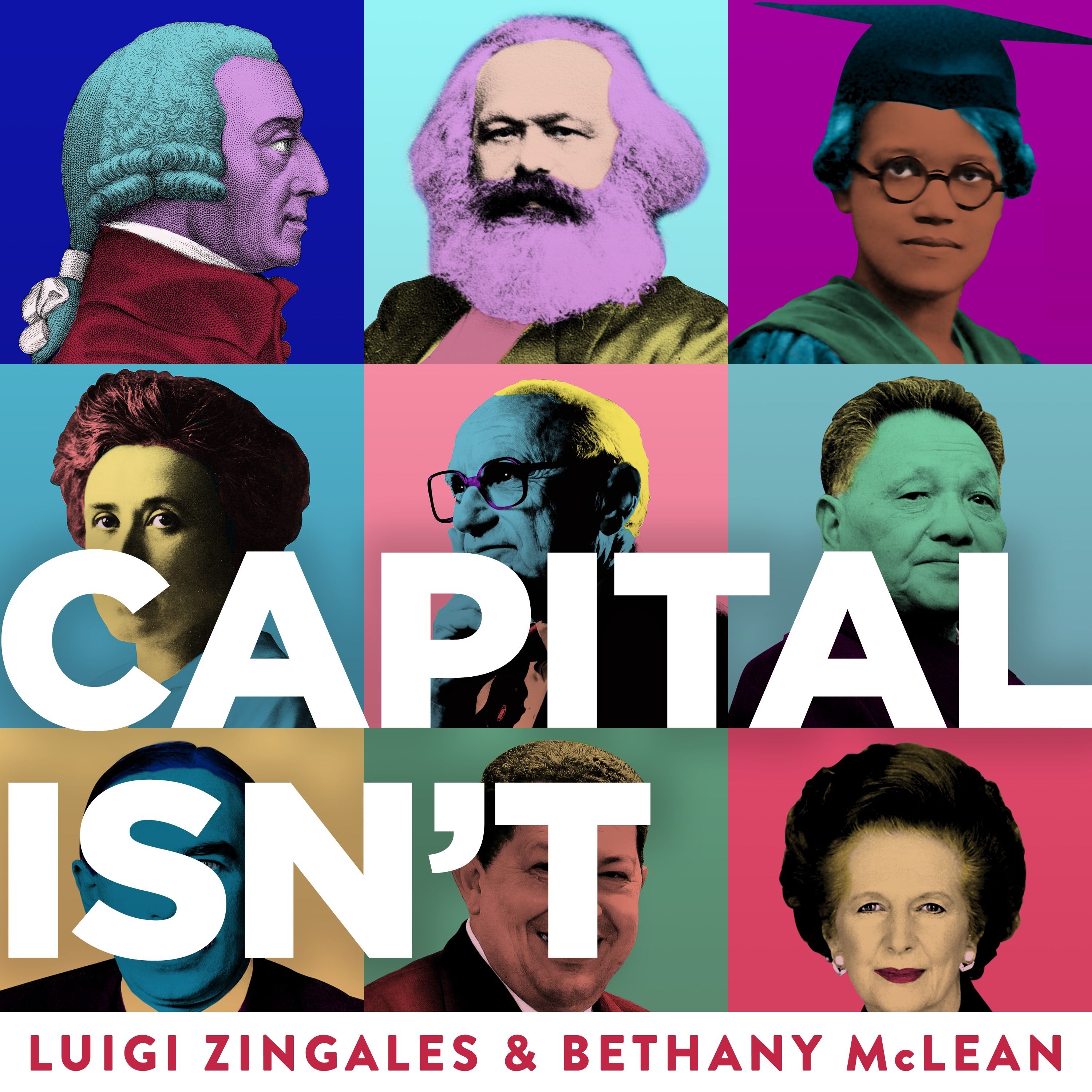
Is capitalism the engine of destruction or the engine of prosperity? On this podcast we talk about the ways capitalism is—or more often isn’t—working in our world today. Hosted by Vanity Fair contributing editor, Bethany McLean and world renowned economics professor Luigi Zingales, we explain how capitalism can go wrong, and what we can do to fix it. Cover photo attributions: https://www.chicagobooth.edu/research/stigler/about/capitalisnt. If you would like to send us feedback, suggestions fo...